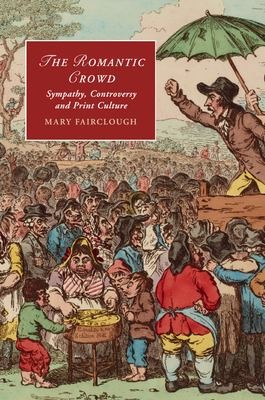
Romantic Crowd
"In the long eighteenth century, sympathy was understood not just as an emotional bond, but also as a physiological force, through which disruption in one part of the body produces instantaneous disruption in another. Building on this theory, Romantic writers explored sympathy as a disruptive social phenomenon, which functioned to spread disorder between individuals and even across nations like a 'contagion'. It thus accounted for the instinctive behaviour of people swept up in a crowd. During this era sympathy assumed a controversial political significance, as it came to be associated with both riotous political protest and the diffusion of information through the press. Mary Fairclough reads Edmund Burke, Mary Wollstonecraft, William Godwin, John Thelwall, William Hazlitt and Thomas De Quincey alongside contemporary political, medical and philosophical discourse. Many of their central questions about crowd behaviour still remain to be answered by the modern discourse of collective psychology"--
- Generi
- English fiction, history and criticism, 19th century, Moral and ethical aspects, British Foreign public opinion, Romanticism, Collective behavior, Sympathy
- Autore
- Mary Fairclough
- Pagine
- 312
Dove trovarlo
Alcuni collegamenti sono di affiliazione: se acquisti, il sito può ricevere una commissione, senza costi in più per te.
Non sai cosa scegliere?
Dimmi i tuoi gusti e ti propongo cosa leggere, in base a quello che ti piace.
Provalo gratisTitoli simili
 The Private Memoirs and Confessions of A Justified Sinner (With A Detail of Curious Traditionary Facts, And Other Evidence, By The Editor) (1824)
 Key to Uncle Tom's cabin (1850)
 Castle in the Air (1990)
 Eating animals (2009)
 Herztier (1994)
 Der Proceß (1825)
 Brave New World (1932)
 Tender is the Night: A Romance (1933)